CIP (Clean-in-Place) System Design Criteria in Food and Pharmaceutical Industrial Plants
Automated cleaning (CIP) system design in hygienic process lines. TACT parameters, EHEDG guidelines, turbulent flow requirements, and validation criteria in stainless pipelines.
Contamination Risk in Hygienic Lines and CIP Engineering
CIP (Clean-in-Place) units, which allow lines to be cleaned untouched and without dismantling between production cycles in food, beverage, and biotechnology plants, are the most fundamental defense mechanism preventing biofilm layer formation and cross-contamination. A flawless CIP process is not merely about pumping chemicals but correctly applying the principles of fluid mechanics.
Sinner's Circle and TACT Parameters
A successful industrial CIP process relies on the optimization of 4 fundamental variables known as Sinner's Circle:
- Time: The contact duration of the chemical with organic residues on the stainless steel surface.
- Action (Mechanical Effect): The shear stress created on the inner walls of the pipe.
- Chemical (Chemical Concentration): Precise control of Caustic (NaOH) and Nitric Acid (HNO3) percentages.
- Temperature: Generally an 80°C - 85°C temperature stability in the caustic phase to dissolve fats.
Turbulent Flow and Minimum Velocity Requirement
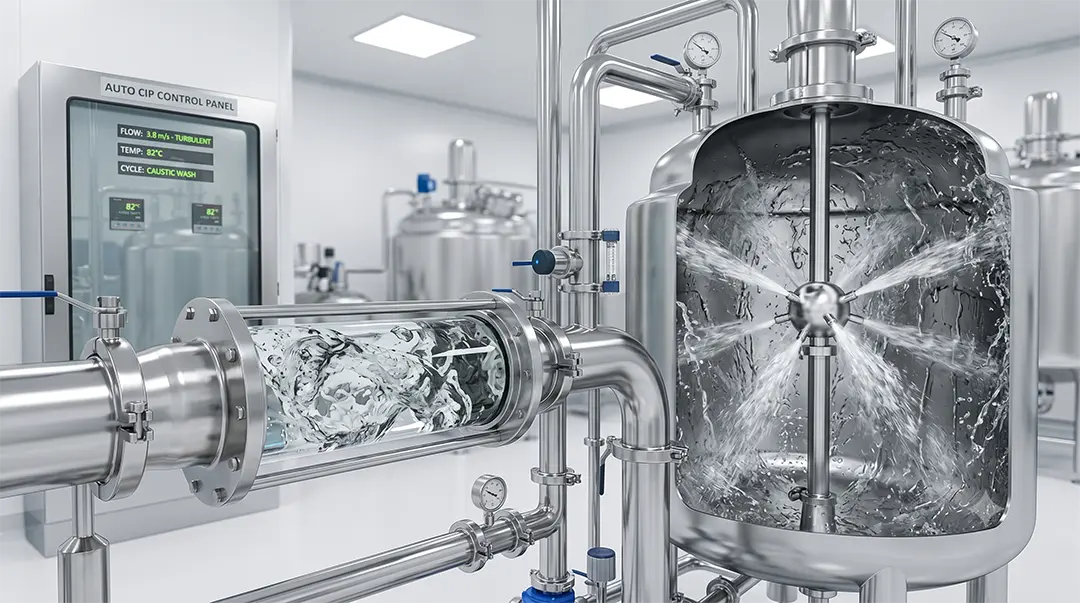
The most common engineering mistake in CIP design is the failure to select a pump flow rate suitable for the pipe diameters. For the mechanical cleaning effect (Action) to occur, the flow must absolutely be in a Fully Turbulent Flow regime.
- Reynolds Criterion: In pipelines, it must be Re > 4000. However, for hygienic assurance, Re > 10000 is targeted in Welltech® designs.
- Critical Velocity: The flow velocity in the lines must be a minimum of 1.5 m/s as mandated by international EHEDG guidelines. When the velocity drops below this value, a laminar flow layer forms on the upper walls of the pipe, and cleaning fails.
Pipelines and Spray Ball Selection
Static or rotary spray balls are used for the internal cleaning of tanks. Rotary jet heads increase the impact momentum of the water, providing up to 50% savings in water consumption. In pipe welding, orbital welding technology must be used, and the internal surface roughness (Ra) must strictly be below the 0.8-micron value.
Welltech® designs automated CIP kitchens and piping lines in accordance with ASME BPE standards for turnkey food and pharmaceutical plants. You can consult our engineers for design validation.