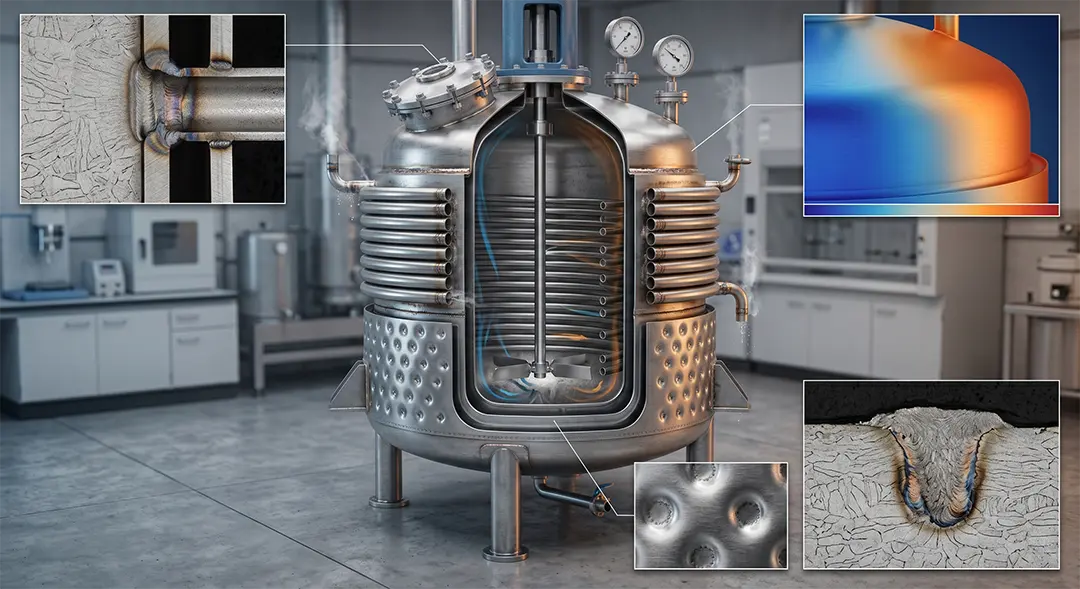
Heat Transfer Jackets in Industrial Reactors: Dimple Jacket vs Half-Pipe Coil
Heat transfer optimization in chemical, pharmaceutical, and food reactors. [cite: 66] Strength and thermal analysis comparison of dimple jacket, half-pipe coil, and conventional jacket designs according to ASME standards. [cite: 67]
Thermal Efficiency and Jacket Geometry Selection in Industrial Reactors
One of the most critical stages in the design of process reactors is selecting the correct heat transfer surface (jacket) that will keep the thermal reaction rate of the fluid inside under control. [cite: 68] While the speed of heating and cooling cycles directly impacts product quality, the jacket geometry determines the total wall thickness of the tank and, consequently, the material cost. [cite: 69]
Metallurgical and Mechanical Analysis of Jacket Types
The Welltech® engineering department optimizes three main jacket geometries based on process pressure and fluid viscosity: [cite: 70]
1. Dimple Jacket (Pillow Plate)
This system, created by applying a press to the sheet surface in specific matrix patterns to form welding points, offers a high heat transfer coefficient (U).
- Strength Advantage: Because the dimple points distribute the load to the inner tank seam, it allows the main body wall thickness to be selected thinner according to ASME Section VIII Div. 1 standards. [cite: 71, 72]
- Flow Dynamics: The dimples create high turbulence in the fluid, preventing the formation of a boundary layer. [cite: 73]
2. Half-Pipe Coil Jacket
It consists of half-circle cross-section pipes welded helically around the shell. [cite: 74]
- High-Pressure Resistance: It reduces the risk of catastrophic deformation to zero, especially in high-pressure thermal oil or high-pressure steam applications of 20 bar and above. [cite: 75]
- Multi-Cycle: By running multiple independent half-pipe lines on the same tank, both heating and cooling phases can be managed simultaneously. [cite: 76]
3. Conventional Jacket
It is formed by fitting a second full cylindrical shell over the outside of the inner tank. [cite: 77] It is preferred for low-pressure and high-volume fluid transfers, but the excessive increase in outer shell thickness at high pressures creates a cost disadvantage. [cite: 78]
Heat Transfer and Nusselt Number (Nu) Criteria
To determine the heat transfer performance of the fluid inside the jacket, Nusselt correlations are used based on the Reynolds (Re) and Prandtl (Pr) numbers in reactor jackets: [cite: 79]
Nu = 0.023 × Re^0.8 × Pr^0.4