Selection of Stainless Steel in Industrial Processes: AISI 304 vs AISI 316L/316Ti
Proper selection of austenitic stainless steel for industrial process tanks, chemical reactors, and storage systems. [cite: 1] Corrosion kinetics and PREN index. [cite: 2]
Metallurgical Importance of Stainless Steel Selection in Industrial Processes
When building liquid storage, heat transfer, and aggressive chemical process systems in industrial facilities, raw material selection is the most critical parameter that determines the operational life, sealing safety, and corrosion fatigue resistance of the project. [cite: 3] Incorrect alloy selection can lead to microbiologically influenced corrosion (MIC) or catastrophic equipment failures. [cite: 4]
Chemical and Technical Comparison of AISI 304 and AISI 316L Standards
The most commonly used austenitic stainless steel alloys in the process industry (Food, Pharmaceutical, Chemical, Biotechnology) are AISI 304 (EN 1.4301) and AISI 316L (EN 1.4404) grades. [cite: 5] The fundamental mechanical and chemical difference between these two alloys lies in their microstructural alloying elements. [cite: 6]
1. Molybdenum (Mo) Addition and Pitting Corrosion Resistance
AISI 316L contains 2-3% Molybdenum (Mo) in its composition. [cite: 7] This addition increases the stability of the passive chromium-oxide ($Cr_2O_3$) layer on the material surface, especially in aggressive environments with high chloride (Cl⁻) ions, and prevents localized pitting and crevice corrosion. [cite: 8]
2. Carbon (C) Content and Intergranular Corrosion Risk Management
The "L" (Low Carbon) designation at the end of the alloys symbolizes that the carbon content is below 0.03%. [cite: 9] To prevent chromium-carbide precipitation ($Cr_C_6$) at high welding temperatures (500°C - 800°C) and to eliminate the risk of intergranular corrosion in weld seam zones, Welltech® always prefers low-carbon austenitic sheets in heavy industry productions. [cite: 10]
PREN (Pitting Resistance Equivalent Number) Formulation
The PREN formula used to measure the theoretical resistance of materials against pitting corrosion is as follows: $PREN = %Cr + 3.3 \times %Mo + 16 \times %N$
- AISI 304 PREN Value: ~19 (Low/Medium Corrosive Environments)
- AISI 316L PREN Value: ~23-25 (Highly Corrosive and Chloride Environments)
Alloy Selection Matrix by Industrial Sectors
- AISI 304 / EN 1.4301: An ideal and cost-effective solution for standard dairy and dairy products, pure water storage units, ventilation ducts, and less corrosive phases of CIP lines. [cite: 11]
- AISI 316L / EN 1.4404: Mandatory for high-temperature chemical process reactors, saline solutions, pharmaceutical (Pharma/WFI) plants, cosmetic mixers, and acidic food (Winery, Juice) processes. [cite: 12]
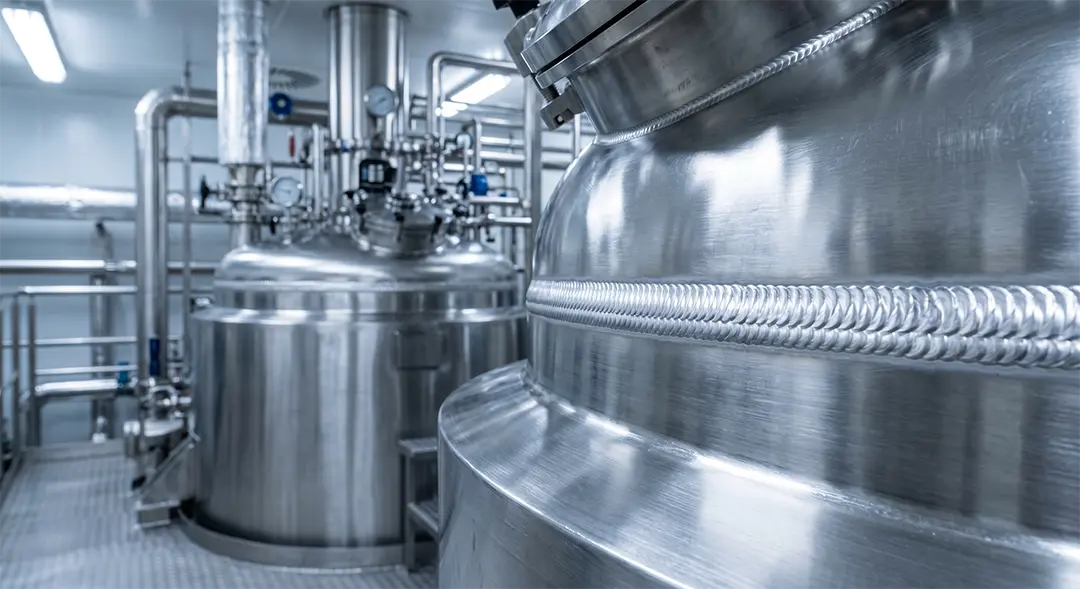
Engineering Authority Note: In pressure reactor designs with a dimple jacket or half-pipe coil, complying with ASME Section VIII Div. 1 and EHEDG (European Hygienic Engineering & Design Group) directives; [cite: 13] certified AISI 316L or titanium-stabilized AISI 316Ti (EN 1.4571) alloys, tested for mechanical strength and corrosion kinetics against chloride stress corrosion cracking (SCC) risk, must be used. [cite: 14]
To put these theoretical and metallurgical insights into practice and to conduct pre-manufacturing material weight analysis, you can use our Welltech® smart engineering calculation tool:
Welltech® Paslanmaz Sac Ağırlık Hesaplama
Projeniz için teorik ağırlık hesaplama aracı
Final Inspection and Non-Destructive Testing (NDT)
Regardless of the stainless steel grade selected, every tank and reactor produced in Welltech® Kemalpasa facilities; [cite: 15] is certified by being subjected to radiographic (X-Ray) tests, liquid penetrant testing (DP), and hydrostatic pressure tests following robotic welding processes. [cite: 16]
You can directly contact the Welltech® expert engineering team to determine the most accurate material thickness and alloy selection based on your project's process requirements (viscosity, thermal load, corrosion resistance) and to conduct mechanical and CFD (Computational Fluid Dynamics) analyses. [cite: 17]