Free Iron Contamination and Chemical Passivation Processes in Stainless Steel Tanks
Restoring corrosion resistance on stainless steel surfaces post-fabrication. [cite: 19] Process analysis of citric acid and nitric acid passivation according to the ASTM A967 standard. [cite: 20]
Why Does Stainless Steel Rust? [cite: 21]
The Danger of Free Iron [cite: 22]
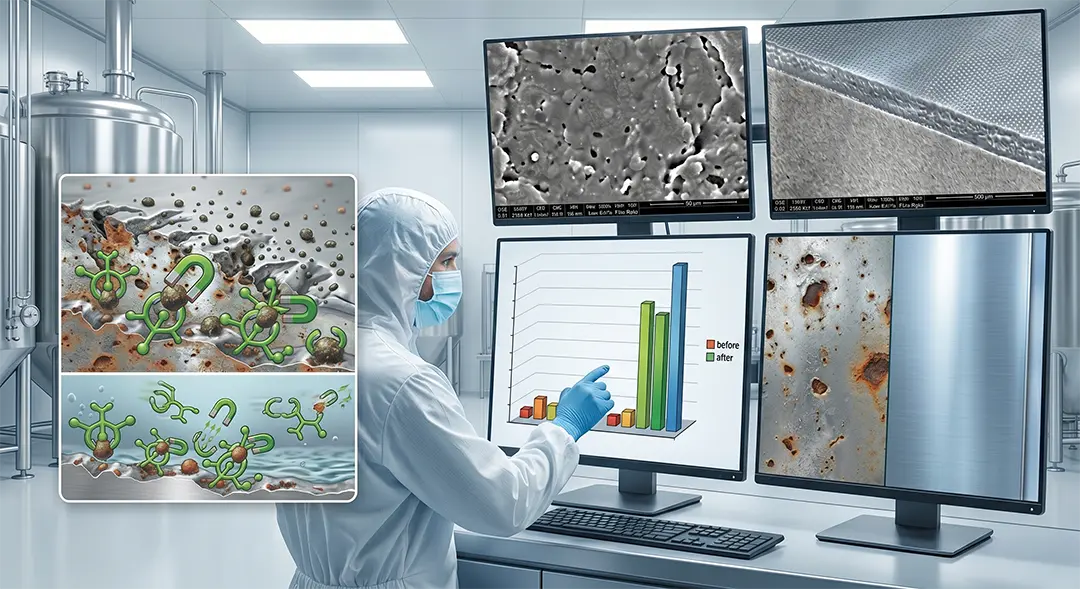
The secret behind stainless steel's rust resistance is the atomic-level Chromium-Oxide (Cr2O3) passive layer on its surface. [cite: 23] However, during manufacturing processes such as cutting, bending, grinding, and welding, microscopic Free Iron particles from surrounding equipment or carbon steel tools contaminate the stainless surface. [cite: 24] These foreign iron atoms penetrate the passive layer and trigger a rusting reaction the moment they come into contact with open air. [cite: 25]
Chemical Passivation Process and Corrosion Prevention Mechanism
Passivation is a controlled acid bath process that chemically dissolves free iron atoms on the stainless steel surface without affecting the chromium atoms, thereby artificially increasing the Chromium/Iron (Cr/Fe) ratio on the surface. [cite: 26] Today, the international ASTM A967 standard is taken as the reference for this process. [cite: 27]
1. Nitric Acid (HNO3) Method
It is a traditional and highly potent method. It rapidly removes free iron and initiates chromium oxidation. [cite: 28] However, it has the disadvantage of generating hazardous gas emissions and causing environmental pollution. [cite: 29]
2. Citric Acid Method (Welltech® Green Technology Standard)
Citric acid, an organic acid, binds exclusively to iron ions through a chelating method. [cite: 30] It is environmentally friendly, odorless, and is applied as the primary standard in Welltech® manufacturing due to its FDA compliance for tanks in the food and pharmaceutical sectors. [cite: 31]
Passivation Validation and Testing Methods
To verify the success of the passivation process, the following non-destructive tests are applied in the Welltech® quality control laboratory:
- Ferroxyl Test: A special solution dropped onto the surface instantly turns blue if free iron is present, decoding contamination at the micron level. [cite: 32]
- Salt Spray Test: The stability of the passive layer of the material is measured in a humid and corrosive cabinet. [cite: 33]
Every process equipment produced at Welltech® Kemalpasa facilities is shipped after being subjected to full passivation and electro-polishing processes following the manufacturing cycle. [cite: 34] Contact us for detailed information about our technical surface standards.