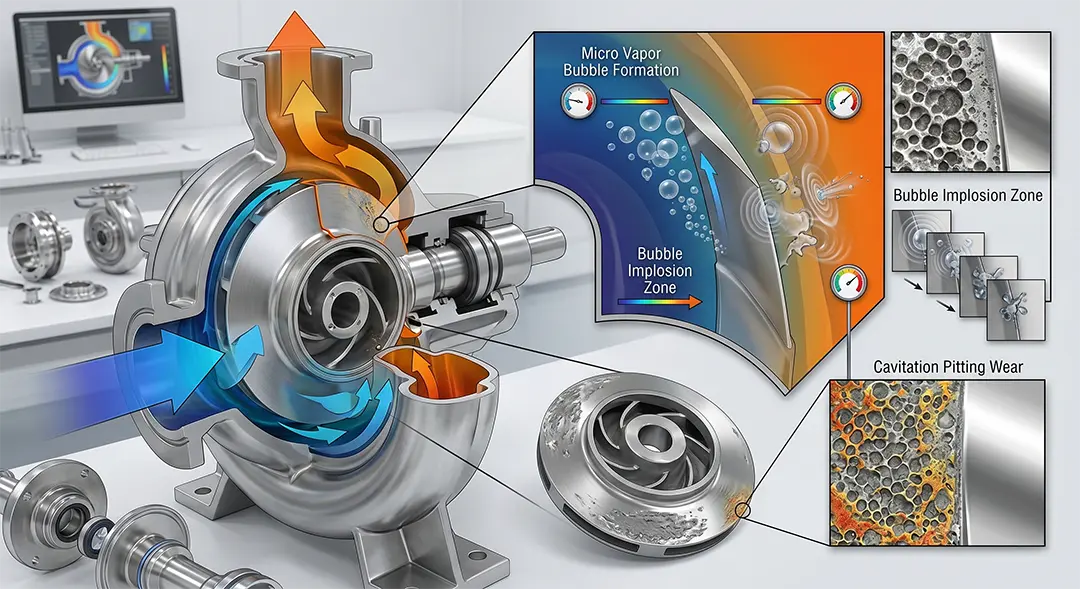
The Cavitation Phenomenon in Hygienic Pumps and NPSH Calculation Methods
Metallurgical effects of cavitation wear in centrifugal and lobe pumps. [cite: 35] Net Positive Suction Head (NPSHa and NPSHr) calculation and a guide to preventing cavitation in process lines. [cite: 36]
Mechanical Damage of Cavitation in Industrial Pump Systems
Cavitation is one of the most destructive physical phenomena encountered while ensuring fluid transfer in process lines. [cite: 37] Micro vapor bubbles form within the liquid as the local pressure of the fluid drops below its vapor pressure (Pv) at that temperature. [cite: 38] When these bubbles reach the high-pressure impeller region of the pump, they collapse through micro-implosions. [cite: 39] The micro liquid jets formed during this collapse send shock waves at GPa levels to the stainless steel surface, tearing the material at a microscopic level (pitting wear). [cite: 40]
NPSH (Net Positive Suction Head) Balance
The only way to theoretically and practically prevent cavitation is to ensure that the Available Net Positive Suction Head (NPSHa) of the system is always greater than the Required Net Positive Suction Head (NPSHr), which is a characteristic of the pump. [cite: 41]
NPSHa > NPSHr + 0.5m (Safety Margin) [cite: 42]